

Today, I’m here to tell you why you should open your coin purse for some of the best gems hiding in plain sight: Adventuring Gear! That’s right, this inconspicuous table on page 150 of the Player’s Handbook has plenty to offer Dungeons&Dragons adventurers of every level. If they’re so readily available, what makes them more advantageous than magic items? There are two key benefits to Adventuring Gear. First, Adventuring Gear is cheap. On average, Adventuring Gear will run you anywhere from one-to-five gold pieces, with items as low as one copper piece.
By comparison, you’ll easily spend well over 1,000 gold pieces for something as uninspiring as +1 Armor, which is considered a rare Magic Item. Second, the possibilities are almost endless when it comes to making the most of your Adventuring Gear. A Wand of Magic Missiles will only ever cast the Magic Missile spell, but a piton, as we’ll explore shortly, can be used for so much more!
While I could espouse the virtues of Adventuring Gear for pages, let’s get to the meat and potatoes of this post. Put on your Explorer’s Packs and coil your rope because today we’re examining five pieces of Adventuring Gear you should be using now instead of saving up for that expensive Magic Item.
1. Piton (5 cp)
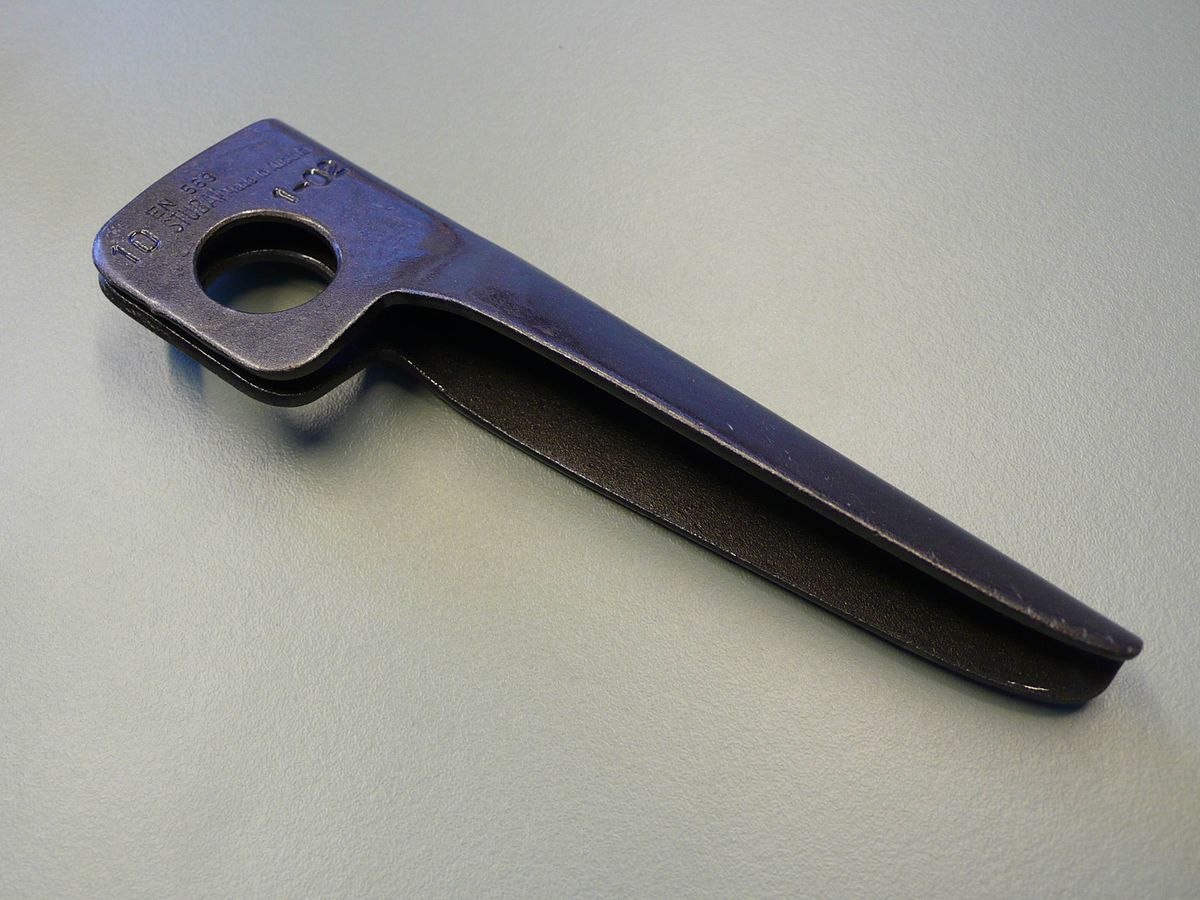
Pitons are simple metal spikes with a hole cut into the flat end, as seen in the image above. For their intended use, a rope is threaded through the hole and then the piton is pierced into the wall being climbed. This makeshift anchor can help adventurers safely scale up or down an otherwise imposing mountainside, castle wall, or any other vertical surface. When climbing a wall, the piton might prevent you from needing to make a risky Athletics check or, if you fail the check, prevent you from taking fall damage.
However, pitons can do more than help you scale walls. Creative dungeoneers can stake two or more pitons can into the ground, thread a thin piece of wire between them, and then connect that wire to a set of bells (for an alarm) or some sharp blades looming precariously above the wire (for a makeshift trap of your own). Or, to secure an object in place (like the arms and legs of an unconscious giant), you can hammer the pitons in the ground around the desired object and then thread heavy rope through the pitons. In a recent session, we used the latter method to brace our Druid, who had Wild Shaped into a bear, for impact with a moving statue we needed to stop to solve a puzzle. With the rest of us behind the reinforced Druid as support, we stopped the statue and were given kudos by the DM for some creative thinking.
For a measly five copper pieces (10 if you want a pair), there are a lot of problems these simple pieces of metal can solve.
2. Bag of 20 Caltrops (1 gp)
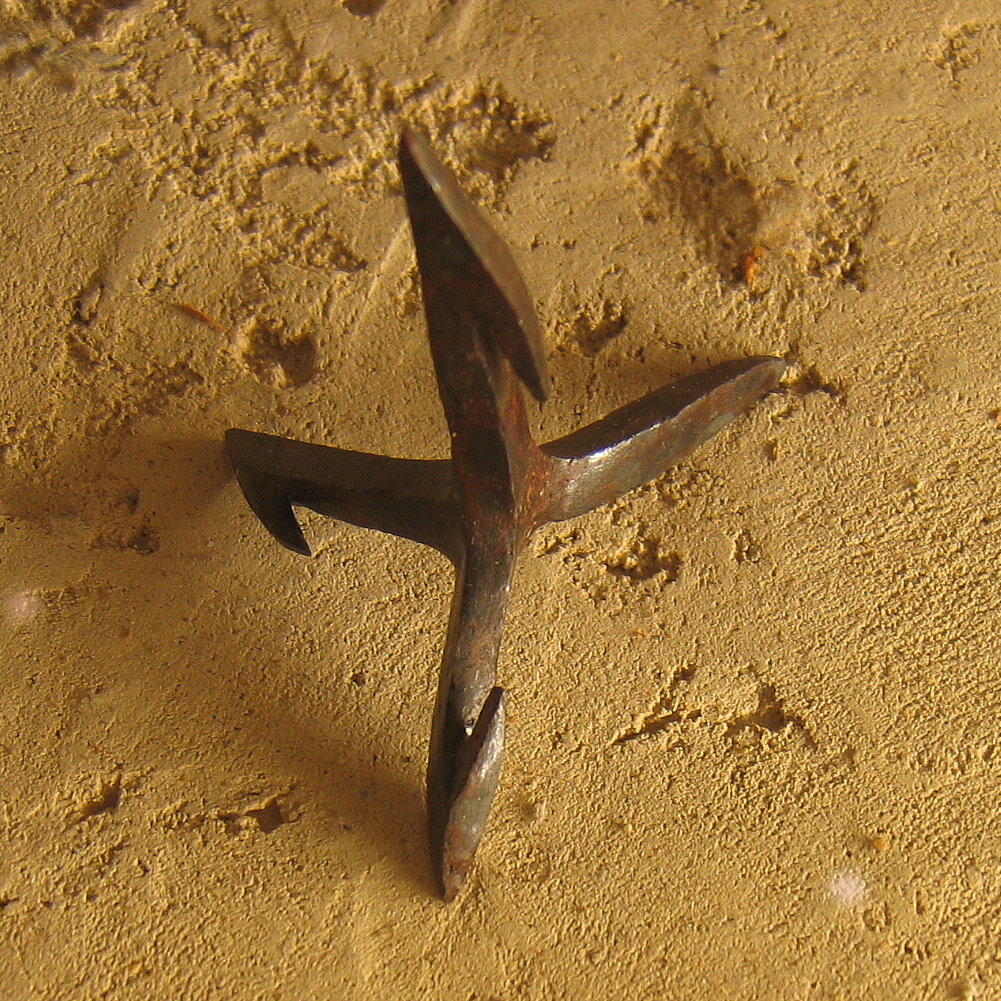
While not as versatile as the piton, caltrops are incredible for their simplicity (meaning most blacksmiths should have them or could make them by request) and viability even into higher-level play. Per the Player’s Handbook on page 151 (bold emphasis mine):
As an action, you can spread a bag of caltrops to cover a square area that is 5 feet on a side. Any creature that enters the area must succeed on a DC 15 Dexterity saving throw or stop moving this turn and take 1 piercing damage. Taking this damage reduces the creature’s walking speed by 10 feet until the creature regains at least 1 hit point. A creature moving through the area at half speed doesn’t need to make the save.
For characters who haven’t invested in the Sentinel feat, caltrops are a fantastic area- and movement-denial resource you can use in a pinch. Not only do the caltrops have a high save DC, but the effects for failing the save are two-fold. The first effect, stopping all movement for the turn, is what will save your bacon in the short term. The second effect, however, will ensure you maintain a safe distance. Unless your enemy has an ally healer or wastes an action to quaff a healing potion, they won’t be catching up to you for the rest of the encounter. To understand how awesome this is, most movement-altering effects in 5th edition are regulated by a strict time limit, a caster’s ability to maintain concentration, or both.
Imagine using these while you’re being chased. Dropping a bag of caltrops in the middle of a narrow street forces the pursuers into a variety of scenarios, all of which reduce their speed for the turn and improve your chances of escape. If they blindly rush through the caltrops, the enemy has to hope they pass a DC 15 Dexterity save. If they want to avoid taking the damage, they need to reduce their speed by half to walk through them. If they try to jump across the caltrops, they’ll waste at least 10 feet of movement getting ready for the long jump.
For wizards, sorcerers, and other “glass cannons” of every level, caltrops are a perfect investment for last-ditch-effort escape attempts when the odds suddenly turn against you.
3. Portable Ram (4gp)
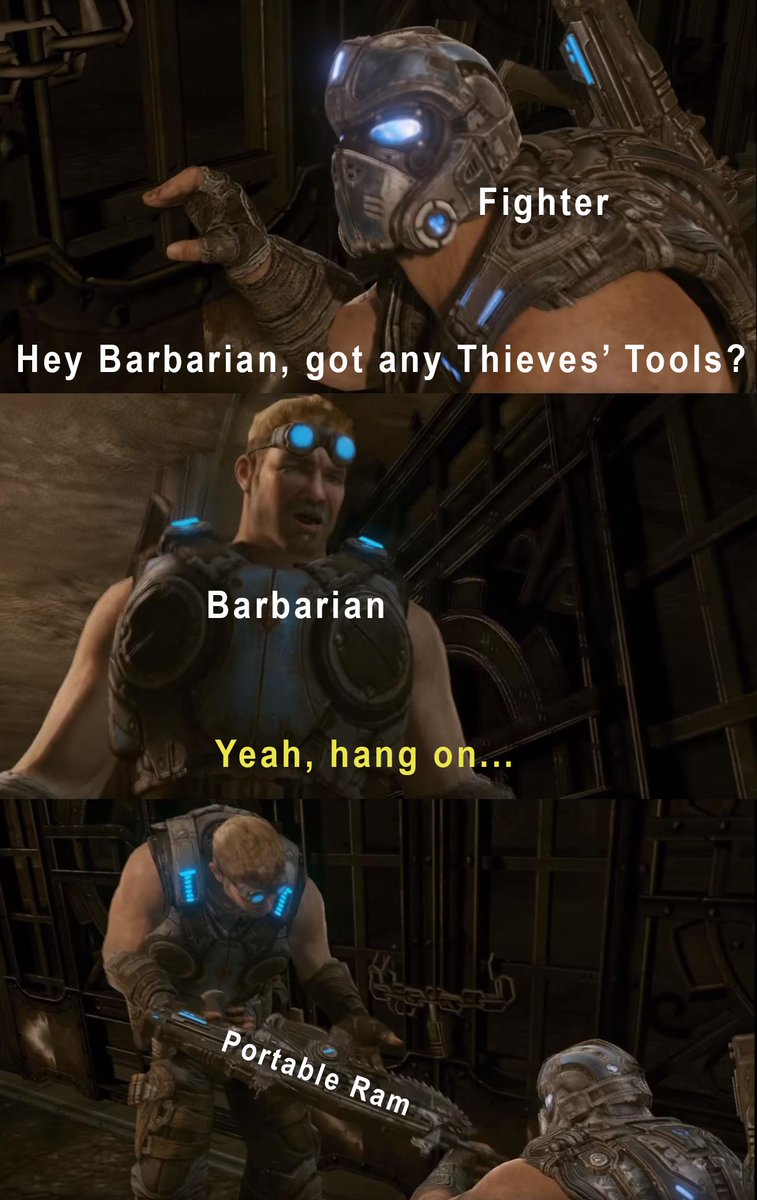
Image courtesy of DND Memes on twitter.
The Portable Ram, if the name were not descriptor enough, is a portable battering ram used to break open tough doors. While the Ram itself gives you a +4 bonus to the Strength check for the attempt, an ally can grab the back of the Ram to give the check advantage. As long as your party strongman is the one using the Portable Ram, most doors will easily crumple under the force of this powerful tool. For parties without a member proficient with Thieves’ Tools, the Portable Ram is an invaluable resource for accessing locked rooms. Of course, the noise it makes when shattering the barrier will remove all pretenses of stealth, so use this item knowing full-well whatever is on the other side will know you’re coming.
With the Rules as Written (RAW), the Portable Ram can only be used on doors, but what if we allowed it to do a little more? In combat, I would allow someone to use the Portable Ram to add a +4 bonus to the Athletics check made to shove a creature. And while we might wish to add a damage value to this use, we don’t want to step too heavily on the Ring of the Ram‘s toes.
Even without a little homebrew, the Portable Ram is a fantastic tool that’s cheaper than even some of the most basic weapons available!
4. Parchment (1 sp)

Although it may seem strange to add this to the list, I cannot tell you how many times my players wanted to write a letter, make a rubbing of an unknown symbol, draw a map, or any number of other tasks that required a simple piece of parchment. Unless one of the player characters has Calligrapher’s supplies, Cartographer’s supplies, or a Forgery kit, parchment and writing supplies are not part of an adventurer’s standard affair. I am aware regular paper is also listed in the Adventuring Gear, but it costs one silver more than parchment and serves the same purposes. I’m nothing if not frugal.
At some point, you or your party should also invest in an ink pen and a vial of ink simply for the ability to write what you want on the fly. However, I’ve purposely kept parchment separate because it has so many standalone uses.
10-Foot Pole (5 cp)

The last item on our list, much like our first item, costs a mere five copper pieces and has nearly limitless applications. Despite the common phrase, “wouldn’t touch it with a 10-foot pole,” this item is the perfect tool for prodding anything that lies ahead of you. Tapping each floor, wall, and ceiling tile may be monotonous work, but it’ll save your party from many a pit or falling ceiling trap. Or, perhaps a suspiciously-placed body in the road needs to be investigated from a safe distance. Curiosity may kill the cat, but not when that cat is armed with a 10-foot pole!
In addition to poking from afar, the 10-foot pole could be used to assist in long jumps (pole vault, anyone?), as a walking/climbing path across a chasm, a way to test the danger of an unknown substance, an impromptu fishing pole, or a rowing pole when traveling shallow ponds or rivers. If, by either foolishness or excitement, a party member races ahead of you and finds themselves in a pit trap, you could even lower the pole to pull them up to safety.
Much like their piton cousins on this list, the ingenuity of the 10-foot pole comes from their affordability. At five copper a pop, you can afford to experiment. If one breaks, dissolves, or becomes otherwise useless, pick up another!
Conclusion
The items we covered today are incredible because their affordability and vague descriptions allow for plenty of experimentation. Even the Portable Ram, which has the most specific definition of how it can be used, is an amazing tool. It’s strange how often I’ve been in parties without Thieves’ Tools or a spellcaster with the Knock spell, and how having a Portable Ram on hand would have been a perfect solution.
To clarify, Magic Items are still incredible and definitely worth the investment. They can usually do one specific task rather well. As we just explored, however, the piton and 10-foot pole have endless applications. You can’t really use that Wand of Magic Missiles to traverse a chasm or set makeshift alarms/traps.
Want even more Adventuring Gear options, including the return of the Sunrod and Tanglefoot Bag? Check out Rosewater’s Incredible Arms, Armor, and Assorted Gear out on the Dungeon Master’s Guild!
Until next time,
Matthew Wulf
Want to stay up to date with the latest happenings on Critical Hit Guru? Click the Follow button and type the email address you want to receive notifications for new posts!
We’re now on Twitter and Facebook! Search for @CriticalHitGuru on Twitter and the Critical Hit Guru page on Facebook to chat, ask questions, or just stay in the loop.
I’m Dungeon Master’s Guild official! For a thrilling military-themed heist all about saving a captured comrade, check out Rescue at Brightwell today.
 Amethyst Wulf Games